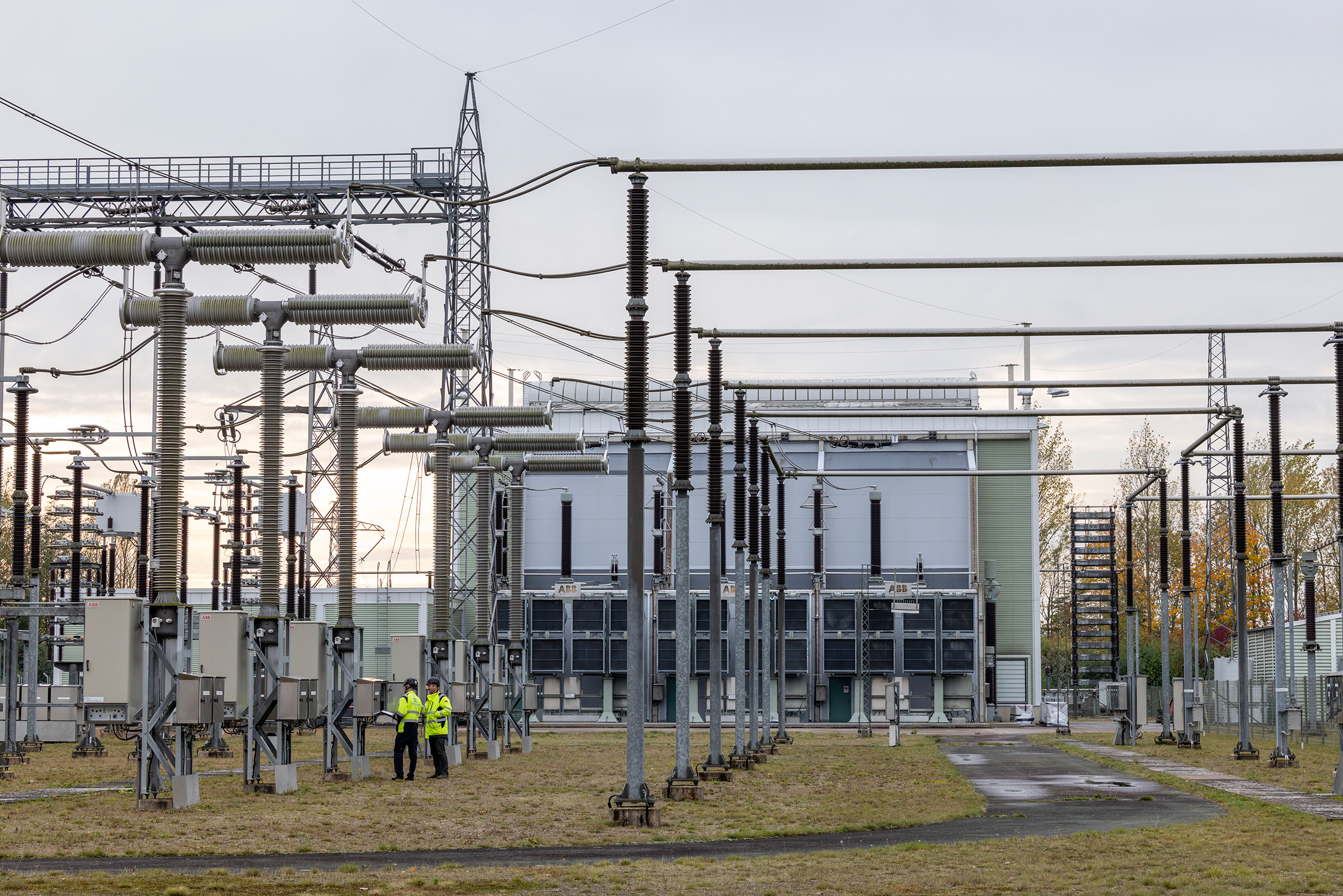
The story of Baltic Cable
Since being commissioned over 30 years ago, the Baltic Cable has lived through more than one reshaping of the energy market. Starting as a purely commercial business initiative in the 1990s, Baltic Cable has increasingly gained strategic significance for the common European energy market. Today, we are fully included in the EU regulations of both energy markets and energy infrastructure that has developed over the past decades.
Milestones:
1994
First transmission of energy
On October 13, 1994 at 13:02, only two years after being granted concession, Baltic Cable transmits the first energy between Sweden and Germany. After trial operations in December, the link transitioned to full commercial service.
1999
First cable fault, cause unknown
2002
Second cable fault caused by a vessel.
2004
Strengthened connection
Connection strengthened in Germany with 400 kV overhead line and SVC, enabling 600 MW power transmission.
Trenching of the cable
Following the second cable fault, a decidion was made to bury the pole cable approximately 1 meter into the seabed to reduce the risk of mechanical damage.
2008
Jan Brewitz joins Baltic Cable as Managing Director
2010
Market coupled
In April 2010, Baltic Cable AB and European Market Coupling Company GmbH (EMCC) signed an agreement to introduce market coupling on Baltic Cable. The target date to start market coupling was Monday 10 May 2010 for delivery on 11 May 2010.
2011
100 % owned by Statkraft
In October 2010, Norwegian utility company Statkraft Energi AS entered into an agreement with E.ON Sverige to acquire the remaining 33,3% of the shares in Baltic Cable AB from 1 January 2011. As a result Baltic Cable became wholly owned by Statkraft Energi AS.
2019
Certified as TSO
On 19 November 2019, by decision of the German Federal Network Agency (Bundesnetzagentur), Baltic Cable AB was certified as TSO according to the provisions of the ITO-unbundling pursuant to section 10 et. seq. German Energy Industry Act (Energiewirtschaftsgesetz).
2020
The 70% rule in force
According to Art. 16 (8) of the Electricity Regulation (EU) 2019/943, Transmission System Operators are required to ensure that at least 70% of the transmission capacity is offered for cross-zonal trade, while respecting operational security limits. Being a TSO that is only operating the HVDC interconnector, Baltic Cable itself has a technical availability of >95% and thus no structural congestion hindering the fulfilment of the 70% rule.
2021
Part of CCR Hansa
The Baltic Cable and the Sweden 4 – Germany/Luxembourg bidding zone border were included in the Capacity Calculation Region (CCR) Hansa. CCRs define geographic areas within the EU where Transmission System Operators (TSOs) coordinate capacity calculation and related processes. As a result, the Baltic Cable is involved in the corresponding regional activities and their continued development.
2022
Full member of SDAC
Baltic Cable became a full participating member of the Single Day-Ahead Coupling (SDAC) cooperation, joining 31 other Transmission System Operators (TSOs) and 17 National Electricity Market Operators (NEMOs). Baltic Cable’s capacity had been already allocated using implicit processes since 2010, and becoming a full member allowed Baltic Cable to participate in the further development of the project.
2024
30-year jubilee
Baltic Cable celebrated 30 years of operations as an interconnector between Germany and Sweden. The company keeps growing and added nine new experts to its team.
Kajsa Hedberg becomes new CEO
Kajsa Hedberg took over as Managing Director, and Jan Brewitz became Technical Director.
2025
Agreement to invest in Greenlink
Baltic Cable AB and Equitix signed an agreement with Partners Group, acting on behalf of its clients, to acquire Greenlink Interconnector (Greenlink). Greenlink connects Ireland with the wider European transmission network, further integrating European energy markets and facilitating decarbonization.